![3 Best Pilot Resume Examples and Templates for [y]](/wp-content/uploads/2025/01/Senior-Level-Pilot-Resume-Examples.x400.pdf.jpeg)
3 Best Pilot Resume Examples and Templates for 2026



Inflight services recruiters decide whether to advance a resume by the credentials block near the top of page one; if the current CDP, fleet qualifications, and CPR certification are not visible there, the file moves to the no-pile.

The New Hire archetype is finishing initial operating experience or moving from hospitality and customer service into the cabin. This resume needs to prove training currency, the aircraft types you are qualified on, and transferable service work under pressure.

The Experienced archetype is line-qualified on two or more fleet types with multi-year reserve and lineholder history. This resume needs to prove safety incident handling, premium cabin service, and senior bid lines awarded.

The Lead FA archetype runs the cabin as purser or A-position on widebody or international routes. This resume needs to prove crew leadership, FAA debrief documentation, and check airman or instructor work if you carry it.

Alejandra Sotelo
Denver, CO | (303) 555-0178 | [email protected] | linkedin.com/in/alejandrasotelo
Flight attendant with 11 years of commercial experience across regional, mainline domestic, and international long-haul flying. Currently qualified on A320, A321, and A330 with lead-line seniority on Latin America routes. Bilingual in English and Spanish, FAA Certificate holder, and CPR/AED instructor for the base.
Lead Flight Attendant
Rocky Summit Airways | Denver, CO | 2019-Present
Flight Attendant
Rocky Summit Airways | Denver, CO | 2015-2019
Cabin Crew
Highland Air Connect | Boise, ID | 2013-2015
Guest Experience Coordinator
Aspen Vista Resort | Aspen, CO | 2011-2013
Lead the summary with flight hours, fleet types, and route mix, not a sentence about your passion for service. An inflight services manager reads the first two lines to gauge whether you can hold a widebody A-position or you need transition training.
Name your years on the line, the aircraft you are current on, and your base. Add one signal of scope: international segments flown, languages used in service, or premium cabin rotations. This frames the rest of the resume as a credible scan.
Service feels qualitative, so most flight attendant resumes drift into adjectives. Recruiters scan for numbers that prove scope: passenger counts per segment, block hours per month, and languages spoken in the galley.
Strong bullets name the fleet (777-300ER, A350, Global 7500), the segment length, and the cabin size you worked. Bullets without scope tend to read as duties. A line like serving 280 passengers across 14-hour Pacific segments lands harder than dedicated to excellent service.
Split bullets into three buckets so recruiters can scan each one. Safety: emergency drills passed, medical events handled, evacuation procedures executed, and FAA reportable events documented.
Service: premium cabin meal service, beverage and duty-free sales, special meal coordination, and unaccompanied minor handling. Crew: pre-flight briefings led, jumpseat positions held, IRROPS coverage, and any check airman, instructor, or union rep work. Galley coordination, conflict de-escalation, and PA delivery belong inside these buckets, not floating as soft skills.
Build a credentials block under the summary listing your FAA Certificate of Demonstrated Proficiency in good standing, current CPR and AED certification, first aid, and food handler permits if your base requires one.
List each aircraft type you are qualified on with current date, plus differences training and any international service qualification. Recruiters need fleet currency visible before the work history because a CDP gap or fleet mismatch is an instant disqualifier. Add passport, TWIC, and Customs Border Protection landing rights status if you fly international.
End with your initial training carrier and graduation year, recurrent training currency, and any instructor or check airman tracks. Listing the academy or carrier where you trained signals which procedures you know cold.
Add languages with the FAA Language of Destination qualification if you carry it, and finish with seniority date and base history if you have multi-base experience. Bid history matters to recruiters reading for reliability and route preference, not just tenure.
The skills below come from flight attendant resumes our users built on ResumeTemplates.com. Inflight services managers and airline recruiters scan hundreds of resumes a week during base class openings, and these are the terms that show up most often. Hard skills carry the screen: FAA safety procedures, CPR and AED, and fleet-specific training are non-negotiable.
Soft skills back up bullets about de-escalation, galley coordination, and crew teamwork. Use the lists against the target carrier’s posting and treat soft skills as evidence for your bullets, not as a standalone block.
| Soft Skills | % of resumes with this skill |
|---|---|
| Customer service | 78% |
| Communication | 60% |
| Composure under pressure | 45% |
| Adaptability | 39% |
| Conflict resolution | 28% |
And here are the top hard skills showing up most often.
| Hard Skills | % of resumes with this skill |
|---|---|
| Emergency safety procedures | 67% |
| First aid and CPR | 61% |
| Aircraft evacuation procedures | 44% |
| In-flight service | 38% |
| Multilingual communication | 34% |
Based on data from thousands of flight attendants’ resumes built on ResumeTemplates.com, May 2026.
These are the must-haves hiring teams look for when scanning a flight attendant resume.
Carrier-specific tablets and POS systems show up in postings as required experience. Naming the platforms you have used signals you can run inflight sales, special meal tracking, and IRROPS rebooking without extra training.
Languages move a flight attendant resume onto premium international bid lines and unlock pay differentials at most carriers. Recruiters need to see fluency level and the FAA Language of Destination qualification if you carry it.
List each language with a proficiency level (Native, Fluent, Conversational, Basic) and note if you passed the carrier’s language assessment. Languages with the strongest hiring lift right now include Mandarin, Japanese, Portuguese, Arabic, and Korean.
If you used the language in service at a prior carrier or in hospitality, name the route or the volume of guest interactions. Self-reported fluency without context tends to read as filler.
Recruiters expect a credentials block on page one with current dates next to each entry. Order the block by what disqualifies you fastest if it is missing or expired.
Put the FAA Certificate of Demonstrated Proficiency at the top, followed by recurrent training date and aircraft-type qualifications. CPR, AED, and first aid sit next, then international travel documents.
Leave certificate numbers off the resume. Recruiters verify those at the application stage; the resume only needs to show currency and issuing body.
Recruiters need to know which bases you can hold and whether you can sit reserve. Spell this out in the summary or a short availability line under the credentials block.
Name your current base, secondary bases you are willing to commute from, and reserve availability. If you are open to relocation, name the bases you would accept rather than writing open to relocation.
Add international availability if you hold the passport, KCM, and CBP landing rights to fly trans-oceanic. This shortens the recruiter’s calculus on bid lines you can hold.
An FAA Certificate of Demonstrated Proficiency and recurrent training keep you eligible. The certifications below are what move a flight attendant resume from the qualified-but-typical stack into a recruiter’s shortlist. List the issuing body, level, and current date next to each entry.
Flight attendant is a mid-sized BLS occupation concentrated at a small number of legacy and low-cost carriers, plus a growing corporate aviation segment. That concentration means seniority date and base carry more weight than role title, and pay is highly hub-dependent.
To position above the median, lead the resume with fleet qualifications, international segment history, and any purser or lead position work, since those are the levers that move a bid line into the higher pay bands.
| # | State | Avg. Annual |
|---|---|---|
| 1 | New York | $128,050 |
| 2 | Washington | $103,950 |
| 3 | Connecticut | $86,140 |
| 4 | California | $77,870 |
| 5 | Florida | $76,410 |
| 6 | Georgia | $76,340 |
| 7 | Massachusetts | $68,650 |
| 8 | North Carolina | $64,100 |
| 9 | Virginia | $62,280 |
| 10 | Illinois | $62,120 |
| # | State | Workers | Median |
|---|---|---|---|
| 1 | California | 15,760 | $77,870 |
| 2 | Texas | 13,180 | $57,170 |
| 3 | Florida | 11,880 | $76,410 |
| 4 | New York | 10,430 | $128,050 |
| 5 | Illinois | 9,230 | $62,120 |
Resume Templates offers HR approved resume templates to help you create a professional resume in minutes. Choose from several template options and even pre-populate a resume from your profile.
One page is the standard, even with 10 or more years on the line. Recruiters scan for fleet currency, base, and seniority date first. A tight one-pager lets those signals sit above the fold. Move to two pages only if you carry instructor, check airman, or union leadership work that needs its own block.
Frame service work in cabin terms: covers per shift becomes passengers served, banquet floors become widebody cabins, and POS systems map to inflight sales. Recruiters care about volume, pace, and how you handled upset customers without a manager in earshot. Name the conflict de-escalation training you have completed, the languages you used in service, and any food and beverage certifications.
No. List the credential as FAA Certificate of Demonstrated Proficiency, current with issuing carrier and date, but leave the certificate number off the resume itself. Provide the number on the carrier's application form when they ask. This is the same pattern recruiters expect for passport, TWIC, and KCM status.
Name it directly. Use a single line under your work history, such as Furlough, Carrier Name, March 2020 to October 2022, with one short note about recurrent training kept current. Recruiters see furloughs constantly and read them as industry context, not a red flag. Hiding the gap with vague dates is what raises questions.
For a flight attendant, an ATS-friendly template is the safest pick, because it puts your certifications and experience where a hiring manager scans first. A basic template is a solid alternative. Whichever you choose, keep the formatting clean and easy to parse: clear section headings, a standard font, and no graphics a parser can choke on.

Certified Master Coach and Academy Certified Resume Writer
Carolyn Couch is a Certified Master Coach, Academy Certified Resume Writer, and Certified Etiquette Consultant. Over the past 20 years, she has helped thousands of professionals start, reinvent, and advance their careers with confidence.
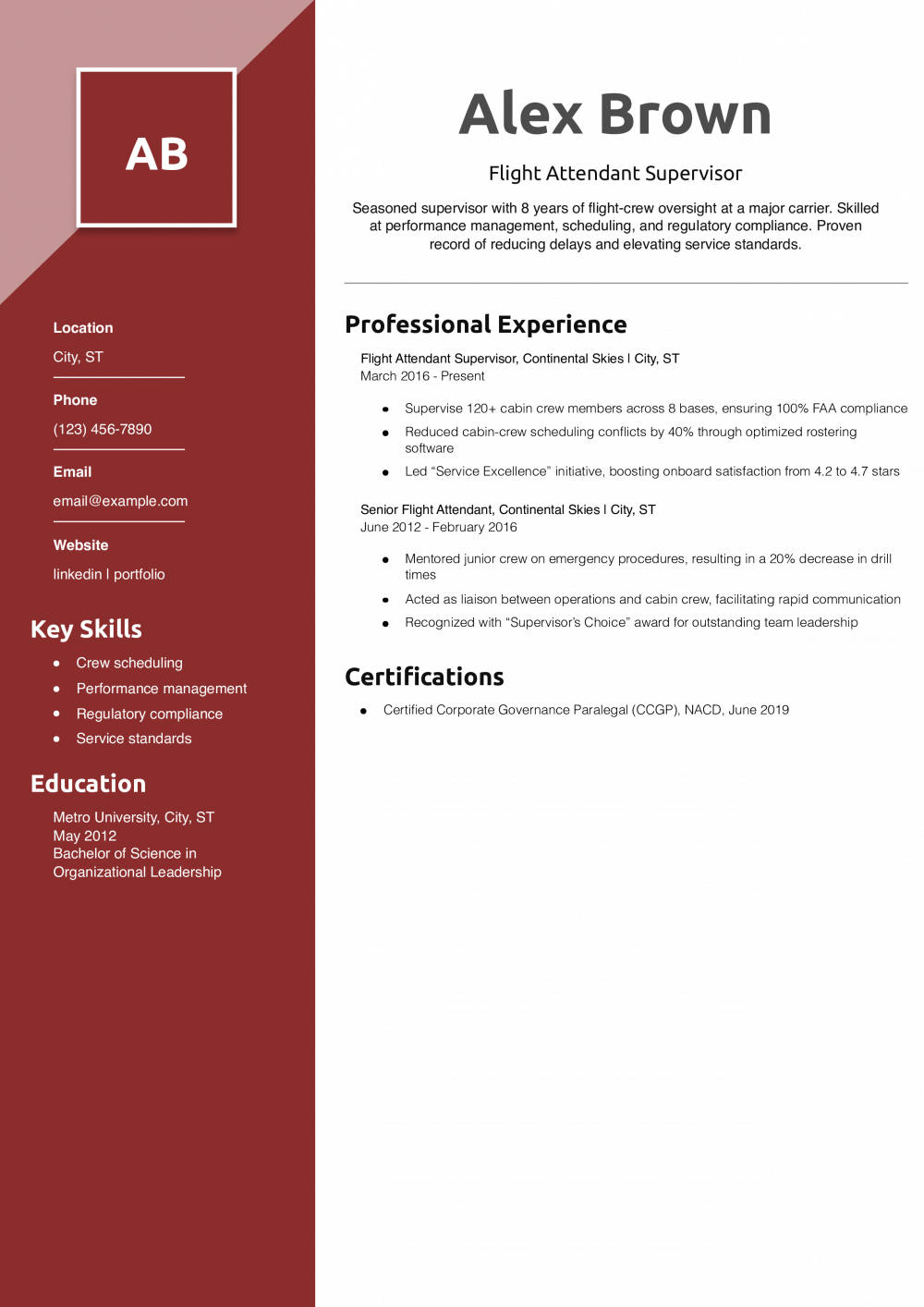
Customize this template in our builder in under 10 minutes.